What's the Difference Between CO2 and Fractional Laser Resurfacing?
Medically reviewed by Dr. Monika Kiripolsky9 min read
 Model
In the fractional laser resurfacing vs CO2 comparison, the difference is depth. CO2 lasers are ablative, meaning they vaporize damaged skin for stronger results with more downtime. Non-ablative fractional lasers heat the layer beneath and spare the surface, so recovery is shorter and results build across several sessions.
Dr. Monika Kiripolsky is a board-certified dermatologist and fellowship-trained cosmetic and laser surgeon who offers fractional CO2 laser resurfacing in Beverly Hills. This guide compares it with non-ablative resurfacing, so you can weigh depth, downtime, sessions, and skin tone before a consultation.
Are Fractional and CO2 Lasers Different Types of Lasers?
Not exactly, and the names cause real confusion. "CO2" describes the type of laser, one that produces light at a wavelength of 10,600 nanometers, which water in the skin absorbs readily. "Fractional" describes how a laser delivers its energy, in a pattern of tiny columns with healthy skin left untouched between them. The two terms overlap, because a CO2 laser can be fractional.
The more useful distinction for patients is ablative versus non-ablative.
- Ablative lasers remove the outer layer of damaged skin. CO2 lasers are the best-known example.
- Non-ablative lasers pass through the surface and heat the tissue underneath, leaving the top layer intact.
Dr. Kiripolsky offers both, with fractional CO2 resurfacing alongside non-ablative laser resurfacing with the ResurFX laser. Comparing the two shows how much depth shapes the experience.
How Does CO2 Laser Resurfacing Work?
CO2 lasers emit concentrated light energy that turns into heat when it meets the skin. The controlled micro-injuries this creates trigger a strong healing response, and the body produces new collagen and elastin. As old, damaged skin is removed and new skin forms, the skin looks smoother, tighter, and fresher.
Some CO2 lasers are fully ablative and treat both the epidermis and the dermis, which causes more damage to the skin and a longer recovery. Fractional CO2 lasers split the energy into a pixelated pattern. Because untreated skin surrounds each treated column, the skin repairs itself faster, and patients get much of the collagen-building benefit of a fully ablative laser with fewer side effects.
CO2 resurfacing is often described as a gold standard for skin rejuvenation. It can reduce fine wrinkles, sun damage, age spots, stretch marks, mild skin laxity, uneven texture, and scars. Because it reaches deeper, it can address problems that have been present for years, such as acne scars and post-surgical scars.
How Does Non-Ablative Fractional Laser Resurfacing Work?
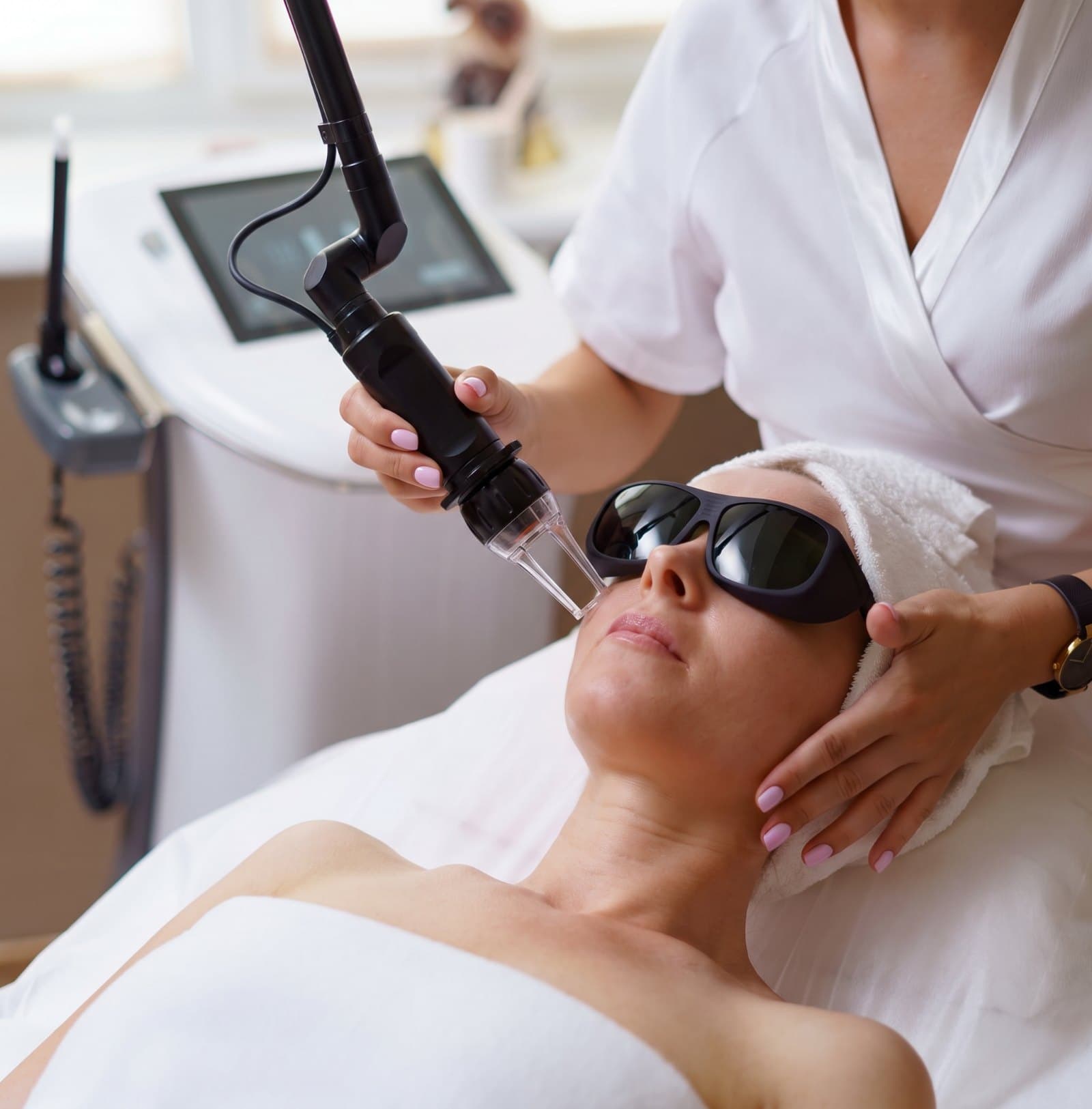
ResurFX uses a wavelength of 1565 nanometers and delivers it in a fractional pattern. Instead of removing the surface, it heats the tissue underneath and triggers new collagen production within the dermis. The device offers over 600 combinations of size, shape, and density, and Dr. Kiripolsky can use low, medium, or high energy settings to reach different depths.
Treatment is gentler and faster. Depending on the area, a session takes about 15 to 30 minutes. A topical anesthetic cream numbs the skin, and a built-in cooling feature adds comfort. ResurFX improves sun spots, liver spots, melasma, fine lines and wrinkles, stretch marks, and mild acne scars, and it can even out skin tone and texture.
How Do Downtime and Recovery Compare?
 Model
This is the question most patients care about, and the answer follows the depth.
After fractional CO2. Expect tenderness for about an hour after the session, followed by skin that looks red and scabbed over. Peeling is a normal sign that you are healing. Research on fractionated CO2 reports roughly 8 to 12 days of social downtime. You will need to wear sunscreen and limit sun exposure for months to prevent pigment changes.
After ResurFX. Redness lasts a few days, and a cold compress helps with any discomfort. Mild scabbing and dryness may follow, and you should avoid picking. Because side effects are mild and short, patients can often return to daily life quickly.
Neither is risk-free, and both require sun protection, but the recovery gap is large. If you cannot take more than a few days away from public life, that alone may decide the question.
Both routes deliver results. In one study, wrinkle and pigment scores improved with every resurfacing technique tested.
How Many Sessions Does Each Need?
CO2 and ResurFX also differ in how many visits you will need.
- CO2. Many patients seeking anti-aging results are satisfied after a single session. Some choose 2 to 4 sessions in total, depending on their needs, with a few months between sessions so the skin heals fully and reveals each treatment's results. Improvements often appear within about 2 weeks of healing, and collagen keeps building over the following 6 months.
- ResurFX. Most patients achieve optimal results with a series of three to five treatments spaced several weeks apart. You will usually see significant improvement after the first session, and collagen continues to regenerate over the following months.
In other words, CO2 packs more of the work into fewer, bigger treatments, while ResurFX spreads it across smaller ones.
Which Concerns Does Each Treat Best?
Choose by concern, because the tools are not interchangeable.
- Deeper wrinkles, significant sun damage, and more severe scarring generally point toward CO2.
- Pigment problems such as sun spots and melasma, fine lines, mild acne scars, and early texture changes often suit ResurFX.
- Redness from broken capillaries, spider veins, or rosacea responds to neither. CO2 lasers are not effective for vascular lesions, and light-based therapy such as intense pulsed light is usually the better option.
Does Your Skin Tone Affect the Choice?
Yes. ResurFX is considered safe for all skin types on the Fitzpatrick scale, which categorizes skin by color and its ability to tan. Fractional CO2 is gentle enough for all skin types for benign conditions, but patients with darker skin tones may be more prone to keloids and pigment changes afterward. If you have a history of keloids or pigment problems, tell your dermatologist so that she can customize your preparation and the laser settings.
The practice also offers CoolPeel, a gentler CO2 laser that uses lower heat levels, for patients who want CO2 benefits with a lower risk of side effects.
How Should You Prepare for Laser Resurfacing?
Preparation reduces side effects. Protect your skin from UV rays by using a broad-spectrum sunscreen with an SPF of 30 or higher and avoiding sun exposure, because UV rays raise the risk of discoloration after treatment. If you have a history of hyperpigmentation, Dr. Kiripolsky may prescribe hydroquinone, and she also prescribes an antiviral medication ahead of CO2 treatment to help prevent a viral infection. Skip exfoliating products and photosensitizing medications in the days before your session.
How Do You Choose Between CO2 and ResurFX?
Weigh how deep your concern runs, how much downtime you can accept, how many visits fit your schedule, and your skin tone. A consultation lets Dr. Kiripolsky look at your skin, review your history, and recommend one laser, the other, or a combination. Laser skin resurfacing in Beverly Hills comes in many forms, and the right match is individual.
Because lasers are powerful tools, the provider matters as much as the device. A guide to choosing the best dermatologist in Beverly Hills explains how to check credentials and training. For acne scarring, Dr. Kiripolsky's acne scarring treatment approach combines lasers with other methods, and microneedling is a gentler option for mild texture concerns. ResurFX can also improve pigment concerns such as melasma. Lasers do not relax expression lines, so some patients pair resurfacing with neuromodulators such as Botox. You can see real outcomes in the practice's ResurFX before-and-after gallery, and you can learn more about Dr. Kiripolsky on her about page.
Dr. Kiripolsky sees patients in Beverly Hills and Newport Beach, and you can book a consultation to find out which laser suits your skin.
Frequently Asked Questions
Is fractional CO2 laser the same as CO2 laser?
Fractional CO2 is a type of CO2 laser. "CO2" names the laser, which produces light at a wavelength of 10,600 nanometers that water in the skin absorbs readily. "Fractional" describes how the energy is delivered, in tiny columns with untreated skin in between, which speeds healing. Fully ablative CO2 treats the whole surface and causes more damage and a longer recovery. Dr. Kiripolsky performs fractional CO2 resurfacing and can explain which approach fits your concern.
Which laser has less downtime, CO2 or ResurFX?
ResurFX has less downtime. It is non-ablative and leaves the surface of the skin intact, so redness lasts only a few days, followed by mild scabbing and dryness. After fractional CO2, expect tenderness for about an hour, then skin that looks red and scabbed over and peels as it heals. Research on fractionated CO2 reports roughly 8 to 12 days of social downtime, and you need to limit sun exposure for months.
How many laser resurfacing sessions will I need?
It depends on the laser and your goals. Many CO2 patients seeking anti-aging results are satisfied after a single session, while some choose 2 to 4 sessions in total, spaced a few months apart so the skin heals fully. Most ResurFX patients achieve optimal results with 3 to 5 treatments spaced several weeks apart. Dr. Kiripolsky will outline a plan after examining your skin.
What does ResurFX treat?
ResurFX improves sun spots, liver spots, melasma, fine lines and wrinkles, stretch marks, and mild acne scars, and it can even out skin tone and texture. A session takes about 15 to 30 minutes. A topical anesthetic cream numbs the skin, and a built-in cooling feature adds comfort. Deeper wrinkles, significant sun damage, and more severe scarring generally point toward CO2.
Can laser resurfacing treat acne scars?
Yes. CO2 lasers can address deeper concerns such as severe acne scars, and ResurFX can improve mild acne scars. Dr. Kiripolsky often combines lasers with other methods such as microneedling, chemical peels, and filler, based on the type of scarring you have.
Who should avoid CO2 laser resurfacing?
CO2 lasers are not effective for vascular problems such as spider veins or rosacea, where light-based therapy such as intense pulsed light is usually the better option. Patients with darker skin tones may be more prone to keloids and pigment changes after fractional CO2, so a history of either deserves a conversation before treatment. Dr. Kiripolsky reviews your skin history during a consultation and tells you whether CO2, ResurFX, or another treatment is the safer choice.
How should I prepare for laser resurfacing?
Protect your skin from UV rays with a broad-spectrum sunscreen of SPF 30 or higher and avoid sun exposure, because UV raises the risk of discoloration. Skip exfoliating products and photosensitizing medications in the days before your session. If you have a history of hyperpigmentation, Dr. Kiripolsky may prescribe hydroquinone, and she prescribes an antiviral medication ahead of CO2 treatment to help prevent a viral infection.

Monika Kiripolsky, MD, FAAD, FAACS
Board-certified dermatologist and fellowship-trained laser and cosmetic surgeon in Beverly Hills and Newport Beach. Every article is written or reviewed by Dr. Kiripolsky.
More from the blog
 ModelLasers & Light
Beauty Buzz for Brides – Part 1
With wedding season approaching, here are some ways that you can prepare... whether you are the bride-to-be, a bridesmaid, mother-of-the-bride, or simply a fabulous guest, the following suggestions can help you to look your best.
4 min read
 ModelLasers & Light
CO2 Laser Resurfacing
Have you ever wondered what A-list actors do to maintain flawless skin on huge movie screens?
3 min read
 ModelLasers & Light
Photodynamic Therapy (PDT)
Since May is Skin Cancer Awareness Month, now is the perfect time to talk about Photodynamic Therapy (PDT).
2 min read