Ever wonder what Hollywood’s secret to tauter, younger-looking skin is? One well-kept secret to a more “snatched” (tight) jaw, higher cheeks, and lifted brows is a thread lift. Thread lifting involves placing needles preloaded with polydioxanone (PDO) threads into the skin to lift and tighten it. These threads have microscopic barbs (cut into them with a laser) that allow them to stay where we place them.
You can think about this procedure as “redraping” skin on the face (and other parts of the body) that has started to sag. The threads dissolve over the next six months, however, more collagen is stimulated by placement of the threads and that collagen remains. The procedure is quick, not too painful, and lasts for about eighteen months.
As a board-certified dermatologist having done an advanced fellowship in cosmetics, I aim to stay at the forefront of research on developing new trends and technologies related to beauty and anti-aging. I’m always skeptical of new techniques (including new lasers and injectables) until they have been out long enough for us to really see how effective (and safe) they are.
Two examples of procedures I’ve waited on introducing into my practice – and am glad that I did – are Qwo (injections to minimize the appearance of cellulite) and Renuvion (introducing helium gas under the skin to tighten it). Both sounded promising, but, from a scientific standpoint, I had concerns about each. Several patients injected with Qwo (treated at an outside clinic) had bruising so intense that residual hyperpigmentation (from hemosiderin deposition) remained after the bruising resolved. I treated these patients with a series of lasers to minimize the hyperpigmentation (while patting myself on the back that I had waited to introduce Qwo to my office).
The company that made Qwo subsequently filed for bankruptcy. I had similar concerns about Renuvion (J-Plasma). It gave the immediate appearance of skin tightening, but, the mechanism of action behind how introducing helium gas under the skin could result in permanent skin tightening did not make sense to me. Thus, I held off on buying the device and offering it to my patients. About a year after I demoed it, the FDA issued a warning against using it for skin tightening/cosmetics.
I waited on introducing thread lifts to my patients until they had been out for several years. I wanted a significant amount of research demonstrating the efficacy and safety of the procedure to become available and, of course, to ensure that the mechanism behind how they work made sense to me. Now that all of this has come to fruition and that I’m doing this procedure on some of Hollywood’s most photographed faces, I’m obsessed with the results. My favorite area to do threads is the jawline, however, we can do them all over the body (including the neck, chest, buttocks, elbows, and knees) to lift and tighten the skin as well as to stimulate more collagen production.
Frequently Asked Questions
What are the threads made of, and how long does a thread lift last?
Polydioxanone (PDO), with microscopic barbs cut into them by laser so they stay where they are placed. The threads dissolve over the next six months, but the collagen their placement stimulates remains — and the procedure lasts for about eighteen months.
Where on the body can thread lifts be done?
Dr. Kiripolsky’s favorite area is the jawline, but they can be done all over the body — including the neck, chest, buttocks, elbows and knees — to lift and tighten the skin as well as to stimulate more collagen production.
Why did she wait years before offering them?
She wanted a significant amount of research demonstrating the efficacy and safety of the procedure, and wanted the mechanism behind how they work to make sense to her. The post names two procedures she is glad she held off on: Qwo, whose maker subsequently filed for bankruptcy, and Renuvion, which the FDA later issued a warning against using for skin tightening.
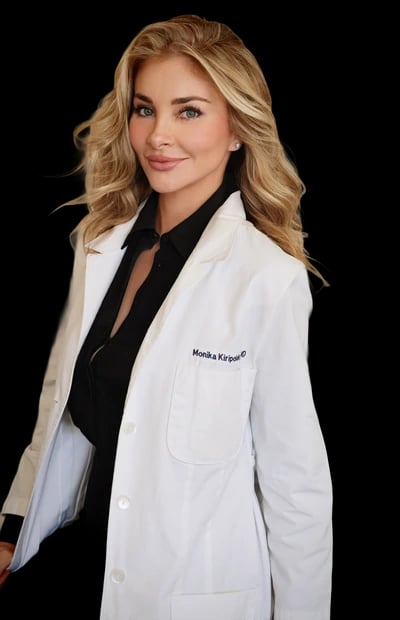
Monika Kiripolsky, MD, FAAD, FAACS
Board-certified dermatologist and fellowship-trained laser and cosmetic surgeon in Beverly Hills and Newport Beach. Every article is written or reviewed by Dr. Kiripolsky.
More from the blog
 Model*Aesthetics
How Many Microneedling Sessions Do You Actually Need?
How many microneedling sessions you need depends on your goal, your skin, and how deep the concern runs. Most patients benefit from a series of sessions spaced a few weeks apart, and acne scars usually call for more visits than general rejuvenation.
9 min read
 Model*Aesthetics
Achieving Clear Skin: Exploring the Best Treatments for Hyperpigmentation
Hyperpigmentation, characterized by patches of darker skin, can be a frustrating skin concern for many individuals. Whether caused by sun exposure, hormonal changes, or skin inflammation, hyperpigmentation can impact one’s confidence and self-esteem.
3 min read
 Model*Aesthetics
Goodbye to Dark Patches and Hello to Brighter Skin
Are you dealing with pesky patches of darker skin? Whether it’s due to too much sun, hormones going wild, or some skin inflammation, hyperpigmentation can seriously mess with your confidence.
3 min read